Pages

Showing posts with label Stanchfield. Show all posts

Thursday, May 02, 2013

High noon happy accident!

About a week ago I was walking into work a bit late and ran into a rugged mean looking cowboy  He had on a black hat, black vest and black villainous mustache.  It was the gesture model John Tucker who most of you know or have heard of on my blog or twitter feed.  

Then moments later a western saloon skirted, high heel boot wearing girl came down the hall and she was very excited to model in the class.  This was Rachel Bailit, one of the most bubbly actress' I know.

I was a bit nervous at first but quickly figured we had a happy accident of having two models pose this day.  Which of course I loved!

One tip I'd like to share about two models in gesture drawing is: Remember the beginning of the sketch is all one big mass shape.  You are definitely trying to capture two different subjects but when you approach the building of the sketch
you want to draw them together as they relate and connect to each other.

Sometimes we start drawing the sketchy gesture lines for only one of two models trying to figure out how they're posed and time is ticking away.  Suddenly the models have moved on and we're left with half a sketch or a ghosty image of the second model that doesn't really allow for a true relationship expressed between the two models.

In the few minutes we give ourselves to get the sketch done we really need to encompass the whole pose in the first few lines of trajectory.  It's not easy!  The challenge is tough but I know that you are passionate and are ready to take it on!  

Here are a few inspired quick sketches I did after noticing that even though these two models never met before- they hit it off like they were old saloon pals.

two minute pose (on twitter I said one minute because I started drawing late into the pose. let's break even at about a minute and a half)

Two minute pose 
Five minute pose


Saturday, December 01, 2012

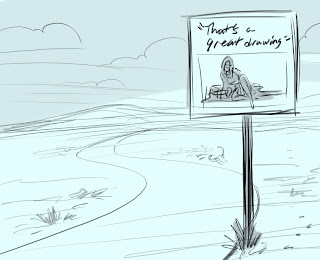
Complimentary sign posts


In the latest class I pointed out a sketch to an artist as my favorite one they did.  The artist replied that it's taken so long to get there.  I sympathized and agreed that it does take time.  Luckily we love doing what we do so we can stick to it and continue to learn.

One thing that's incredibly important though is to realize that moment when you've achieved a sketch worthy of a mentor's praise.

The drawing that an instructor points out is the drawing that should jettison you to that next level of focus. 
You must be conscious of the fact that you did something good that is on the right track.  Pay attention to that compliment and treat it as a  "sign post" that leads you to further focused development.  Then ask which way now?   That sketch becomes your new start position and other bad ones fall away. 

Missing that complimentary sign post can leave you aimlessly drawing without focus and hoping that you'll magically get better.  Notice that drawing that's pointed out and follow its guidance.  The best part about this is you actually drew it!

Monday, November 12, 2012

Centerline Box thought

Walt Stanchfield used to really get cranky when our sketches where too straight up and down.  So when I'm teaching (and drawing my own sketches) I try to tell the artist to LEAN the pose, push that hip out, move the pose more left and right etc....

If you imagine a box around the drawing from it's furthest edges you should be able to also imagine a centerline down the middle.  That centerline helps you see if the drawing is too straight up and down.  It also helps to keep the work asymmetrical and balanced.

My sketches below show the box that I'm talking about.  I didn't actually draw the box but I was thinking "no straight up and down, no straight up and down!"

Hopefully this works for you because it really helps me to get that LEAN in that Walt talked about.

Forgive the quality of the Iphone pics.


Tuesday, October 02, 2012

Make Mistakes!


Michael Jordan: "I failed ovrer and over and over again in my life....and that is why I succeed."
When I saw this commercial many many years ago it stuck with me!  It opened my eyes to the idea that you really have to try and try and try and continue to strive for your goals.  No matter where we are in your career we will always make mistakes and we shouldn't be afraid of them.  Whether you're animating, storyboarding, gesture sketching, etc...

The major key to mistakes is having someone in a mentor like role or trusted friend noticing the problem and helping you correct them.  We need to make mistakes and make them as much as possible to eventually create art that we like or reach goals aimed for.  Younger artists can get easily discouraged when it comes to making mistakes and feeling like they aren't at the level they'd like to be.  I like to tell these artists to save their sketches so that they can reflect back and see how good they've gotten.  

The whole idea is to learn and grow and if we are too shy or scared to show mentors (or trusted friends) our work and search for constructive criticism in correcting our mistakes we will stay at the same level we're at. 

Glen Keane told a story of how when he entering Disney, he filled up 10 sketch books, 100 pages each in a week.  He showed them to Eric Larson who on the average chose 1 in 10 sketches that were good enough to present to the company.  The rest is history for Glen as we know it.

The truth of his story was that he didn't have any fear of failing, making mistakes and showing his mentor his work.  I'd say Glen is sort of the Michael Jordan of animation wouldn't you?

Here are a few recent sketches of mine,  seems the theme was back shots this day.

Monday, July 02, 2012

Abstract shapes

Recently I've been asked how to get the "whole" body into a drawing in the time it takes to get a gesture down.  Some artists fall into a piece meal kind of sketching where they draw the form sections separately from one another.  I encourage and challenge you to strive to capture the whole gesture as one piece as early as possible when sketching.

I like to think of the whole gesture as an abstract shape that encompasses the feel and attitude I'm going for.  Within the first ten to fifteen seconds of the drawing I'm blocking out shapes that allow the gesture to live within it.

Henri Matisse inspires me with his abstract silhouette paper cut outs when I think of this direction.  The deceptive simplicity is very impressive and I believe we can be inspired by his work.

Henri Matisse
When gesture drawing we don't really have time for too much detail, we need to get the whole thing down fast.  I like to call this abstract shape the trajectory of a pose.   It's a planning stage that allows you to buy the impression you are creating and sends the drawing in a direction allowing you to finish even if the subject has moved on.

In thinking about this stuff I decided to take a break from the Cintiq and slum it with the chinamarker on paper.  I sketched this stuff out of my head and wrote lil' notes to assist my thoughts above.  All sketches were done quick in under a minute each for the more detailed.

Draw! Draw! Draw!


Friday, May 18, 2012

Observational Drawing


I want to share my impression of what it means when I say observational drawing.  
Many times people can get the idea that observational drawing means to literally observe every nook and cranny of the object or model.  Wrinkles, cracks, knuckles, follicles, pours, nose hairs or whatever can be seen is put into the artwork.  
I think there can be a place for such detailed type of artwork but when I teach the idea of observational drawing I teach the study of story telling through drawing.  That’s the most important part of it all.  If the drawing conveys story and meaning it’s that much more valuable as a piece of art.  
We need to connect with the meaning of our drawings.  If there's no story or meaning to the drawing that was supposed to be from observation then theres less interest by the viewer.  it becomes lines smudges and medium on paper rather than impressions of moments captured that evoke an emotion or reaction.
That’s my goal in observational drawing.  To capture a story or a meaning that makes you think or inspires you to feel something.  One thing I definitely do not do is force anyone into a particular style by forcing details into their art that don’t tell the story.  
the key is what are we observing?  the Story or literal detail that can add up to no meaning?
Don’t let style define substance.  

These one and a half second sketches were of my wife in P90x mode.  I tried to convey the energy in the effort and I thank her for letting me show these.  Frankly I should have joined her.  I could stand to loose a few pounds haha.


Tuesday, April 24, 2012

Monday, March 05, 2012

The Drawing Pivot point

I always talk about long lines when it comes to drawing.  Long connective lines and shapes help unify the drawings so that there's a harmony and rhythm to it.

When drawing, a good way to keep those lines and shapes flowing is to pivot from the shoulder.  NOT from the wrist.  Drawing from the wrist limits our ability to get fluidity and movement in your work.  Also  when drawing from the wrist the shapes tend to not connect to each other as they're drawn shape by shape.

Try it next time you're drawing.  Keep your wrist in comfortable position and draw by pivoting from your shoulder.  It may take getting used to but it's totally worth it in the long run.

Tuesday, February 28, 2012

Back at Disney's


This week I'm officially back at the Walt Disney Animation Studios.  I couldn't be more happy to join such amazing and talented artists who are all so happy and eager to make great films.

It's been a while since being at the studio and there are many new faces along with many old ones who I had so much pleasure to see again.  The buildning has undergone many cosmetic changes within but walking through on a tour today brought out dream like memories of experiances long ago.  Some say that walls have memories - today I felt them.

I can remember moments in the corridors of every corner I walked into.  I remembered old production pods of films past and offices that I spent many days in.  Some corners and offices aren't even there any longer as the studio is still undergoing it's metamorphisis.

There was one particular room I went into today that was the most important room of the day for me.

The Art Studio.

The Life Drawing room that Walt Stanchfield held his class in.  The very room where he walked and taught many many artists including me.

As Stephanie (our guide) walked all of us "newbies" into the room, I passed bye them quietly.  No one knew what I was feeling, no one knew why I was whistfully walking into the room and taking in a deep breathe of reminiscence.

I was pleased to see all the drawing horses that he walked around and the cabinets that held all the supplies we used.  The smell of the air was exactly the same as when Walt stood over our sketches with that keane eye.

I felt Walt in the room, I felt his spirit.  As if he was saying with a wink, "Welcome back!"

We all walked out as I held a lump in my throat, I smiled and winked back saying "thanks Walt."

When all of you out there work with students and mentees - remember that your words and teachings can stay with people forever.  The lessons that enlighten us and help us grow are those lessons that live in on as artist's use them to build careers and eventually pass them on.

Walt left such an impression on me and my life I can't thank him enough.  Hopefully being back in the halls where he stood, he'll know how much gratitude I have for all he did for me and so many others.