Pages

Showing posts with label Constructive Criticism. Show all posts

Wednesday, August 14, 2013

Be Resilient!

Just a thought...

The Merium Webster definition of the word "resilience" is written this way:


The capability of a strained body to recover its size and shape after deformation caused especially by compressive stress.

This is the exact word that came to mind as I considered being in story.  The idea of being able to snap back after receiving criticism or corrections is extremely important to your psyche and your longevity in your career.  

Consider this idea of recovery after getting notes.  We all get notes and we all must correct our work per director and leadership opinions.  We spend time making choices and digging into our weekly tasks and sometimes that compressive stress or deformation comes in the form of corrections.  

It's normal!  you just have to be resilient!  You must be able to understand that ideas will change and evolve.  The best part about it that you can grasp onto is you are a part of a greater movement to make your project great.  

This thought also helps when you're a student trying to get into the studio system.  When you get that constructive criticism or feedback be resilient and do the changes!  Work hard to fix and change and open up your possibility of reaching your goals!

Take care.

Sunday, May 05, 2013

Remember it's ART.


I carry a sketchbook with me just in case inspiration hits.  Long ago I used to draw randomly and aimlessly in my sketchbooks believing that it was the shear act of doing it that would make me a better artist.

I was pouring out little sketches all across the page.  All the poses looked similar and none of them had any spark.  They all blended into one another in a way were not one sketch commanded it's own presence.  It also took forever to fill a sketchbook and the pages didn't seem like they were important because there was no focus on anyone sketch.

One day I worked up enough courage to show Glen Keane one of my books and he was kind enough to look.  After a few flipped pages he stopped looking and told me that my images were hard to focus on because I had way too many small sketches on the page.  He kindly spent time sifting through the book and looking for some sketches he liked, but I felt he was really stretching as he complimented.  In the end his advise was to draw one drawing per page and really focus in on what that one pose was trying to say or do and really study it.  He said,  "remember, each page is a piece of art!"

Glen's advise made me realize that every sketch is one that you can learn from, it deserves it's time from you. each sketch needs your focus and study. 

Each sketch is "ART" and it deserves it's own page!

When we focus in on one drawing per page that sketch becomes so important.  The choices become more definite.  The lines become very directed as the emotion and attitude illuminate from the page.

With that said mistakes are more evident- but you learn more from your own executions with each page you fill.  When I buy a new sketchbook I can't help but look at the page count and think that that's how many sketches will be in that book.

Gone are the days of unfocused sketches that randomly sit on a page.  Every page in my books now have become valuable to the sketch that sits on them.  Even if I don't agree with that sketch it still deserves it's day to shine.

Boldly give it a go!  I think you'll find great challenge to the approach.

The first four pieces are from Starbucks the other day and the last gesture from a lacrosse game on tv.


Saturday, December 01, 2012

Complimentary sign posts


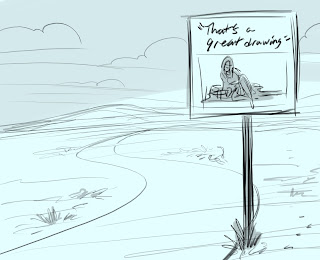
In the latest class I pointed out a sketch to an artist as my favorite one they did.  The artist replied that it's taken so long to get there.  I sympathized and agreed that it does take time.  Luckily we love doing what we do so we can stick to it and continue to learn.

One thing that's incredibly important though is to realize that moment when you've achieved a sketch worthy of a mentor's praise.

The drawing that an instructor points out is the drawing that should jettison you to that next level of focus. 
You must be conscious of the fact that you did something good that is on the right track.  Pay attention to that compliment and treat it as a  "sign post" that leads you to further focused development.  Then ask which way now?   That sketch becomes your new start position and other bad ones fall away. 

Missing that complimentary sign post can leave you aimlessly drawing without focus and hoping that you'll magically get better.  Notice that drawing that's pointed out and follow its guidance.  The best part about this is you actually drew it!

Tuesday, October 02, 2012

Make Mistakes!


Michael Jordan: "I failed ovrer and over and over again in my life....and that is why I succeed."
When I saw this commercial many many years ago it stuck with me!  It opened my eyes to the idea that you really have to try and try and try and continue to strive for your goals.  No matter where we are in your career we will always make mistakes and we shouldn't be afraid of them.  Whether you're animating, storyboarding, gesture sketching, etc...

The major key to mistakes is having someone in a mentor like role or trusted friend noticing the problem and helping you correct them.  We need to make mistakes and make them as much as possible to eventually create art that we like or reach goals aimed for.  Younger artists can get easily discouraged when it comes to making mistakes and feeling like they aren't at the level they'd like to be.  I like to tell these artists to save their sketches so that they can reflect back and see how good they've gotten.  

The whole idea is to learn and grow and if we are too shy or scared to show mentors (or trusted friends) our work and search for constructive criticism in correcting our mistakes we will stay at the same level we're at. 

Glen Keane told a story of how when he entering Disney, he filled up 10 sketch books, 100 pages each in a week.  He showed them to Eric Larson who on the average chose 1 in 10 sketches that were good enough to present to the company.  The rest is history for Glen as we know it.

The truth of his story was that he didn't have any fear of failing, making mistakes and showing his mentor his work.  I'd say Glen is sort of the Michael Jordan of animation wouldn't you?

Here are a few recent sketches of mine,  seems the theme was back shots this day.